
Interactions
John Harrison
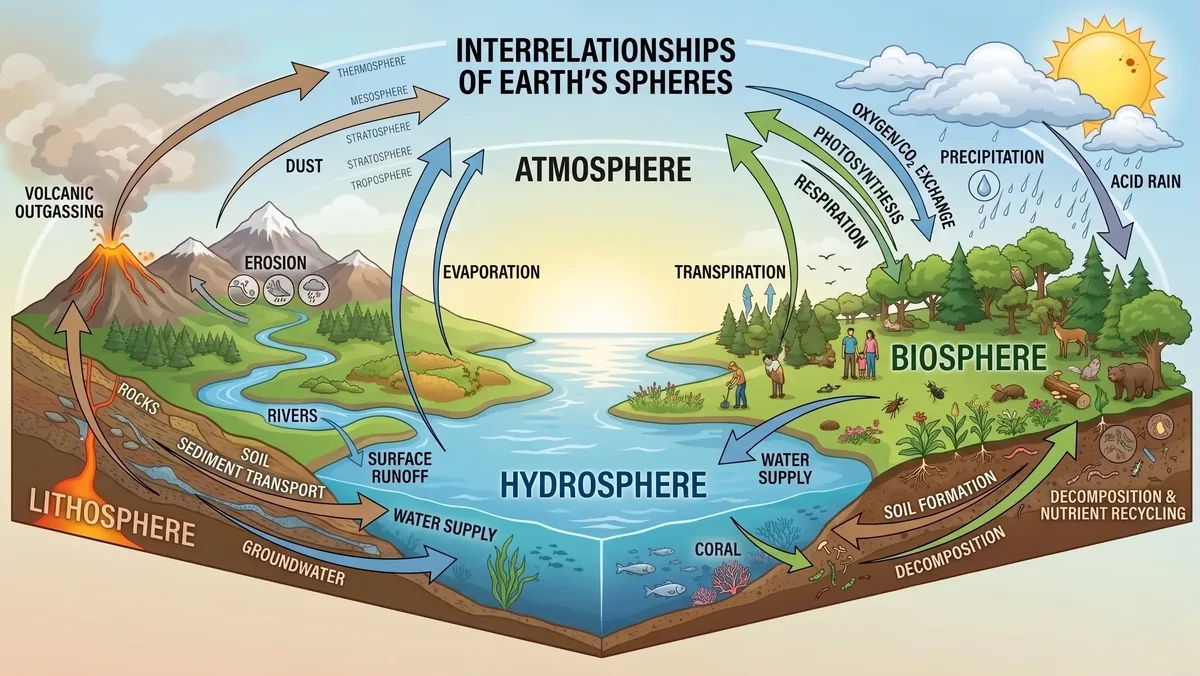
Prior to human modification, Earth functioned as an interconnected, self-regulating system driven entirely by solar radiation and internal geothermal heat. The lithosphere served as the planet's solid crustal bedrock, constantly reshaped by tectonic forces and volcanism. Volcanic outgassing injected essential water vapor, carbon dioxide, and fine mineral dust upward through the atmospheric layers from the dense troposphere up to the thermosphere.
As wind and atmospheric currents beat against exposed rock, erosion gradually broke down mountains, producing sediments that were swept down river channels and distributed across lowlands into ocean basins.
The hydrosphere acted as the vital fluid link between the land and the atmosphere. Driven by solar energy, ocean and surface waters evaporated into the air, forming clouds that redistributed freshwater across continents through precipitation. Surface runoff carved river valleys into the landscape, while groundwater filtered through porous soil and rock strata. This continuous hydrological cycle dissolved minerals, replenished aquifers, and supplied marine environments with nutrient-rich runoff that fostered coastal systems like coral reefs.
Thriving at the intersection of land, water, and air, the biosphere actively sculpted its environment. Vegetation absorbed groundwater and captured atmospheric carbon dioxide, releasing oxygen through photosynthesis and returning moisture back to the atmosphere via transpiration. Animal and microbial life sustained balanced nutrient exchanges through respiration. When organisms died, decomposers recycled organic matter back into the ground, accelerating soil formation and returning vital elements to the topsoil. Through these continuous feedback loops, Earth's natural spheres maintained a dynamic global balance.
Anthroposphere
The first members of the genus Homo appeared roughly 2.8 million years ago. The anthroposphere is the part of the Earth system that is made shaped, or modified by human activity, it is the interconnected network of human making. As Earth system scientists like Peter Haff emphasise that technology is not merely a collection of tools that humans command from the outside; it functions as an autonomous geological force on Earth. Because humanity depends on this global system to survive, humans act as components inside the system, serving as its consumers, operators, and essential maintenance crew to keep it running.
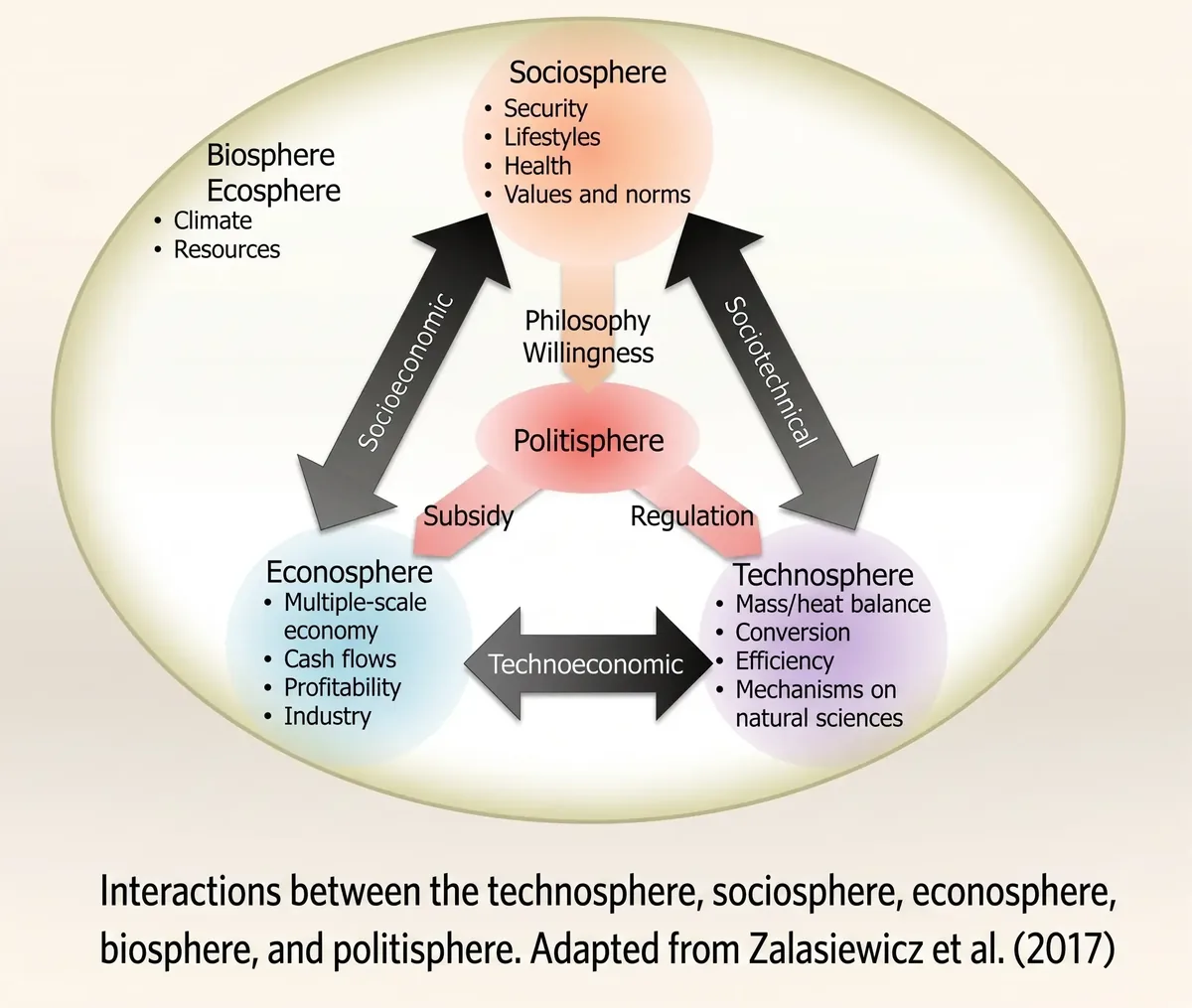
The Biosphere and Eco-sphere
The biosphere consists of the living (biotic) components across Earth's habitable zones, whereas the eco-sphere integrates those biotic components with non-living (abiotic) support systems which include the atmosphere, hydrosphere, lithosphere and energy mainly from the sun.
All human and technological activity takes place inside the biosphere, which enables life and regulates everything including climate and resources.
- Climate: Global thermal regulation and atmospheric conditions that constrain technological throughput and stability.
- Resources: Raw materials, natural energy inputs, and environmental sinks that absorb physical waste and heat.
Primary Structural Subsystems
1. The Sociosphere (The Human & Cultural Subsystem)
Encompasses human well-being, social values, and daily living patterns that generate behavioural demand.
- Security & Health: Baseline human needs for safety, medical protection, and physical survival.
- Lifestyles & Habits: Daily energy usage patterns, technology adoption rates, and living arrangements.
- Values & Norms: Cultural ethics, risk perception, technological optimism, and societal acceptance.
2. The Econosphere (The Resource Allocation & Financial Subsystem)
Manages monetary valuation, capital allocation, and market mechanisms that fund physical expansion.
- Multiple-Scale Economy: Interconnected financial systems spanning local trade to global markets.
- Cash Flows & Profitability: Venture funding, market credit, public investment, and price structures driving technological research and output.
- Industry & Accounting: Financial frameworks tracking production costs, labor inputs, and environmental overhead.
3. The Technosphere (The Hardware & Production Subsystem)
The physical engine itself—factories, machinery, power grids, and digital networks operating under natural scientific laws.
- Mass & Heat Balance: Thermodynamic rules governing raw material inputs, energy dissipation, and entropy.
- Conversion & Efficiency: How effectively industrial machinery converts raw resources into usable goods and power.
- Applied Natural Sciences & Labor: Engineering standards, technical specialization, and routine maintenance protocols that keep physical infrastructure operational.
4. The Politisphere (The Central Governance Engine)
Occupies the core position in the system, acting as the structural mediator that channels societal values into binding rules and incentives.
- Philosophy & Willingness: Absorbs cultural ethics and consensus from the sociosphere to formulate political policy.
- Subsidy Mechanisms: Channels public funds, tax incentives, and state aid directly into the econosphere.
- Regulatory Frameworks: Imposes legal constraints, environmental standards, energy protocols, and safety rules onto technospheric hardware.
System Interconnection Vectors
- Socioeconomic Vector (Sociosphere ↔ Econosphere): Translates human health, security, and lifestyle priorities into market demand, labor supply, and economic activity.
- Sociotechnical Vector (Sociosphere ↔ Technosphere): Connects daily human living directly to physical technology, balancing life convenience against exposure to industrial pollution and technological risk.
- Technoeconomic Vector (Econosphere ↔ Technosphere): Channels market capital and corporate profits into factory output, energy conversion, and industrial efficiency.
References
- Fischer-Kowalski, M. and Haberl, H. (2007) Socioecological Transitions and Global Change: Trajectories of Social Metabolism and Land Use. Cheltenham: Edward Elgar Publishing.
- Haff, P.K. (2014) 'Technology as a geological phenomenon: implications for human well-being', Geological Society, London, Special Publications, 395(1), pp. 301–309.
- Herrmann, C., Schmidt, C., Kurle, D., Blume, S. and Thiede, S. (2014) 'Sustainability in manufacturing and factories of the future', International Journal of Precision Engineering and Manufacturing-Green Technology, 1(4), pp. 283–292.
- Kikuchi, Y., Nakai, M., Kanematsu, Y., Oosawa, K., Okubo, T., Oshita, Y. and Fukushima, Y. (2020) 'Application of technology assessments to co-learning for regional transformation: a case study of biomass energy systems in Tanegashima', Sustainability Science, 15(5), pp. 1473–1490.
- Zalasiewicz, J., Williams, M., Waters, C.N., Barnosky, A.D., Palmesino, J., Rönnskog, A.S., Edgeworth, M., Neal, C., Cearreta, A., Ellis, E.C. and Grinevald, J. (2017) 'Scale and diversity of the Physical Technosphere: A geological perspective', The Anthropocene Review, 4(1), pp. 9–22.
Papers are available as pdfs at https://gaiaengineering.org/earths-spheres
© 2026 John Harrison, TecEco. Licensed under Creative Commons Attribution-Non Commercial 4.0 International (CC BY-NC 4.0). You are free to share, copy, and redistribute this material in any medium or format, provided you give appropriate credit to the author and do not use the material for commercial purposes. Join the Vanguard: www.tececo.com
© 2026 John Harrison. All rights reserved.