
Productivity
The Productivity Paradox and the Case for AI
Mitigating Administrative Drag through Tax Simplification and Verified Natural-Language Ai Interfaces
Abstract
National productivity statistics and real Gross National Income (GNI) per capita have flatlined across developed economies for decades (Brynjolfsson, Rock and Syverson, 2019). While macroeconomic commentary routinely focuses on big tech and corporate capital expenditure, OECD data demonstrates that large "frontier" corporations have maintained steady productivity growth while the small business and subcontractor sector has severely stagnated (Andrews, Criscuolo and Gal, 2015). Constituting over 90% of commercial entities, small businesses, independent tradespeople, and subcontractors are forced to navigate a hyper-fragmented ecosystem of mandatory digital portals, perpetual software subscriptions, and tax compliance overhead (ASBFEO, 2019). Converting master tradespeople, practical specialists, and independent experts into uncompensated, amateur IT administrators starves the economy of billable hours, accelerates the permanent extinction of irreplaceable trade skills, breaks learning pipelines, fuels a retreat into the informal economy (Black Economy Taskforce, 2017), and depresses national living standards. Reversing productivity decay requires a dual-track strategy: legislative tax simplification modeled on broad-based frameworks like New Zealand’s GST (Evans et al., 1996; OECD, 2020), and the deployment of natural-language AI as an invisible administrative shield. Crucially, to make this framework bulletproof against software misinterpretation and legal liability, AI interfaces must incorporate mandatory aviation-style "Roger that" read-back verification and statutory "safe-harbor" protections for non-technical practitioners.
Section I. The History: The Post-1970s Decoupling and Civilizational Stakes
Civilizational advancement relies on sustained growth in Total Factor Productivity (TFP), the ability to generate greater economic output from a given unit of labor and capital. For centuries, technological leaps directly elevated human living standards. However, beginning in the late 1970s, TFP growth across developed nations entered a structural slowdown (Brynjolfsson, Rock and Syverson, 2019).
Early computing, from punch cards to microcomputers to modern networks initially amplified human logic under strict hardware constraints; operators focused on raw problem-solving and direct task execution. As software matured into a massive commercial industry, its trajectory diverted. Instead of expanding the operational capacity of the end-user, modern software transformed into an ecosystem of walled gardens, subscription-based models, and complex administrative layers. Capital investment shifted from physical production and core execution toward managing compliance systems, continuous software updates, and digital tracking.
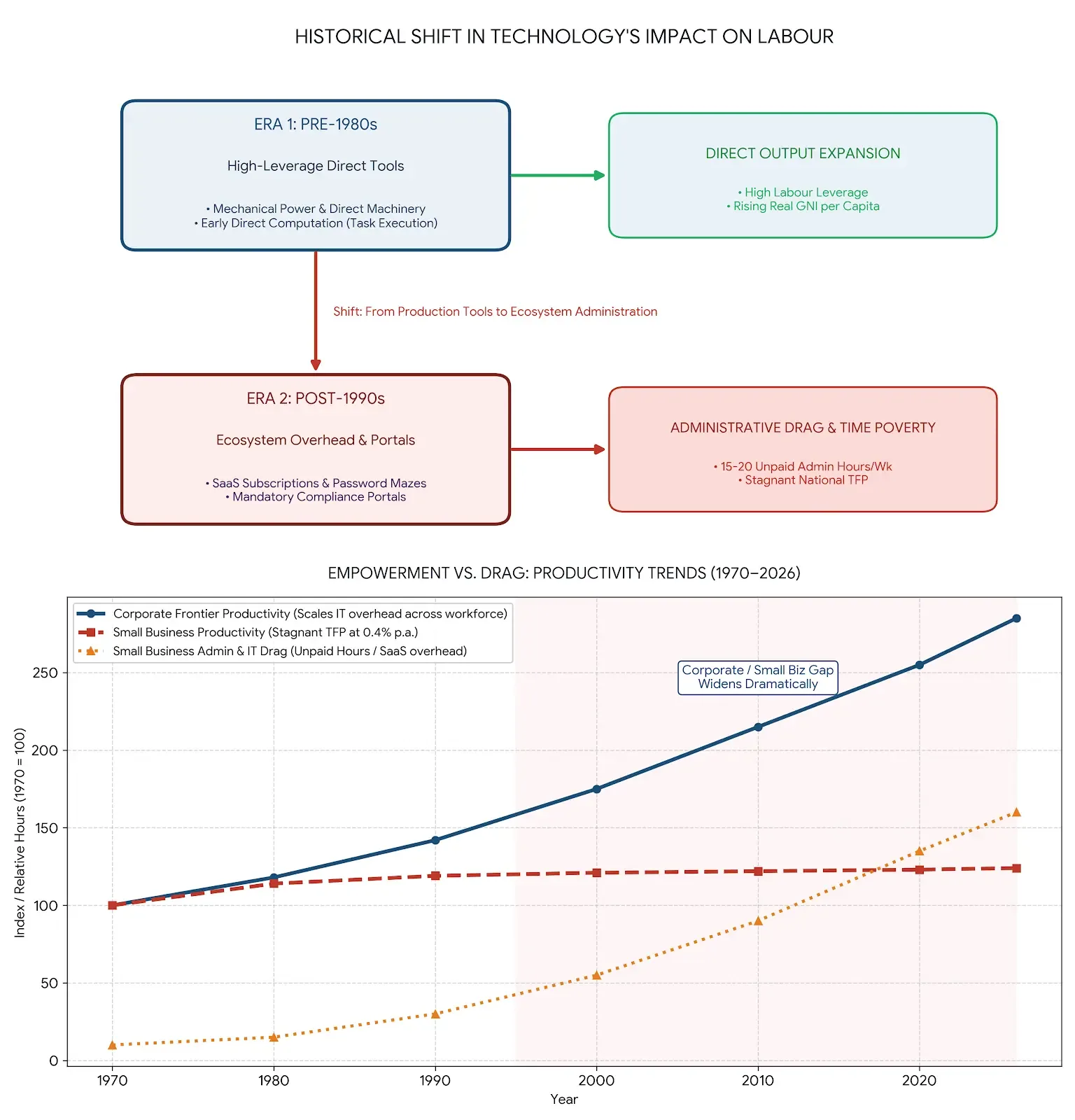
Note on Inflation and Margin Compression: While official total factor productivity (TFP) figures are already adjusted for general inflation, the true financial drain on micro-enterprises is vastly understated. Software subscription fees and compliance costs have routinely outpaced general CPI growth. Compounded by a lack of corporate pricing power to pass these overheads onto customers, every lost billable hour represents a progressively harsher penalty on real household income.
Crucially, this decay is asymmetrical. OECD firm-level data reveals that large "frontier" corporations have continued to achieve productivity gains of ~3.6% annually in services. In contrast, non-frontier small businesses have seen productivity growth collapse to 0.4% per year (Andrews, Criscuolo and Gal, 2015). Large firms leverage economies of scale to absorb IT overhead across thousands of employees, while the independent small business and subcontractor sector carries the full weight of systemic drag alone.
Section II. Where We Are Right Now: The Small Business Crisis and the Permanent Loss of Practical Skills
Independent tradespeople, subcontractors, mechanics, and small professional practices represent the primary engine of market-driven employment and the sole living repository of practical, specialised human craft. Yet, this sector suffers its most severe margin squeeze in fifty years, driven by an unsustainable administrative tax.
Structural Friction Point |
Operational Reality for Small Business & Subbies |
Empirical & Cultural Impact |
Unavoidable IT Costs & SaaS Wealth Siphon |
Transition from capital tool ownership to perpetual Software-as-a-Service (SaaS) rental fees across invoicing, dispatch, and diagnostic systems. |
Direct margin erosion; capital is siphoned out of local economies directly to foreign software monopolies. |
The Unpaid "Second Shift" |
Operators spend 15 to 18.5 hours per week after hours managing portal logins, multi-factor authentication, and software errors (ASBFEO, 2019; CPA Australia, 2022). |
Up to 40% of total workweek lost to admin; total output per hour in micro-firms sits at half that of large corporates (Andrews et al., 2015). |
The Extinction of Master Craftsmanship |
As small practices fold under administrative weight, tacit practical knowledge (complex diagnostics, custom fabrication, specialised trades) disappears permanently. |
Large corporations standardize and simplify tasks, but cannot replace the deep problem-solving craft lost when independent operators exit the market. |
Broken Apprenticeship Pipeline |
Routine tasks (drafting, basic reporting, entry-level admin) are fragmented into digital portals rather than taught on the job. |
Junior workers lose foundational learning ground, creating a severe long-term shortage of master-level practitioners. |
The Existential Risk to Trade Knowledge
When an independent trade business or small practice fails due to administrative burnout, society does not merely lose a taxpaying entity, it loses un-codifiable human capability. Master mechanics, veteran builders, specialised artisans, and experienced practitioners possess intuitive, diagnostic skills built over decades of hands-on work. Corporate consolidation cannot replicate this craft; it replaces specialised problem-solving with rigid, low-skill assembly processes. If small businesses cannot thrive, the deep practical knowledge that underpins physical infrastructure, maintenance, and specialized care will be lost for generations.
Section III. The Off-Grid Escape Hatch and the Limits of Algorithmic Enforcement
Faced with escalating digital friction, a growing segment of the small business economy has adopted a rational defence mechanism: stepping off the digital grid (Black Economy Taskforce, 2017). When the cost and time required to maintain formal digital compliance exceed operating profits, migrating to cash-in-hand transactions, direct barter, and informal networks becomes a matter of economic survival.
This retreat creates severe macroeconomic distortions:
The Algorithmic Blind spot: Revenue agencies deploy machine-learning models to cross-reference digital footprints (bank feeds, land registries, payment gateways). However, these algorithms are fundamentally blind to non-digital transactions. As more operators move off-grid, the data fed into tax models becomes skewed, lowering industry baselines and creating a cat-and-mouse dynamic (Black Economy Taskforce, 2017).
Distorted National Statistics: Official GNI and GDP metrics measure recorded transactions. As skilled trade craft migrates into the shadow economy, living standards may endure locally, but official data reflects an artificial economic decline.
Compliance Punishment: Highly compliant small operators carry an unfair share of the tax burden, while those forced off-grid remain isolated from formal capital markets and business expansion.
Section IV. Structural Distortion: Baumol’s Disease and the Care Economy
The micro-enterprise drag is further compounded by a massive macroeconomic reallocation of labour toward state-subsidised, non-market sectors. Under Baumol’s Cost Disease, sectors with flat intrinsic productivity (such as healthcare, aged care, and administrative compliance networks) experience rising labour costs driven by economy-wide wage pressures (Baumol, 1967).
Over the past two decades, state-supported care frameworks have absorbed an unprecedented share of the total workforce. While socially vital, hands-on care roles inherently yield limited hourly TFP growth. As a result, the wealth-producing small business sector must carry a heavier tax and regulatory load to fund an expanding non-market workforce, precisely while its own billable capacity is being drained by digital administration.
Section V. The Irreversibility Principle & Dual-Track Relief
Society cannot voluntarily regress to an analog era; the volume and velocity of modern global commerce render paper ledgers impossible. Because background complexity is permanent, reversing productivity decay requires attacking administrative friction through a dual-track approach: Legislative Simplification and Technological Buffering.
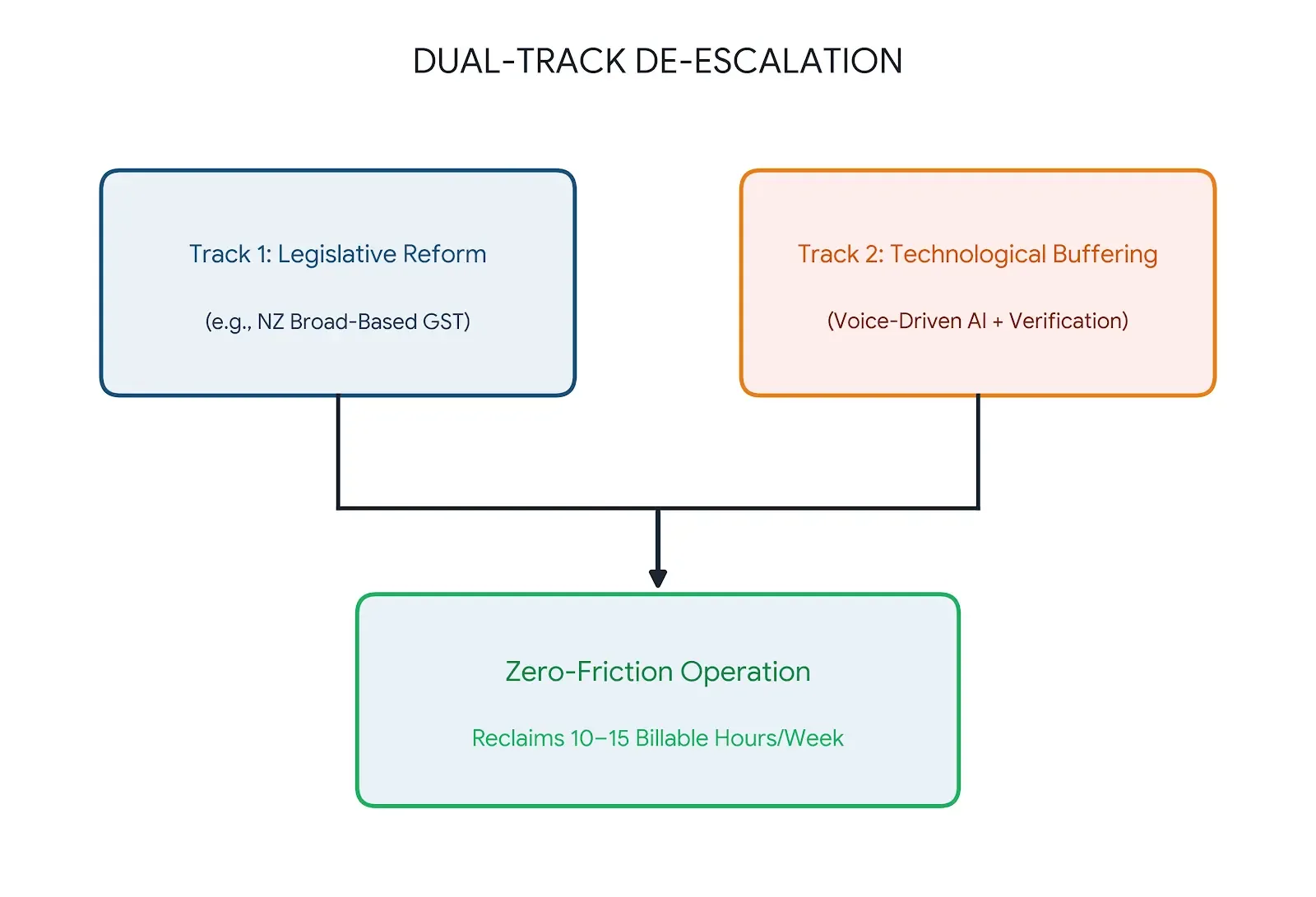
Track 1: Legislative Simplification (The NZ GST Model)
Complex tax regimes force small businesses to act as amateur tax accountants. Frameworks that require continuous line-item classification (taxable vs. GST-free vs. input-taxed) create severe friction. Adopting a broad-based, exemption-free GST model similar to New Zealand’s system eliminates line-item classification disputes (Evans et al., 1996; OECD, 2020). Total revenue minus total expenses yields the tax base, stripping away hours of quarterly accounting friction.
Track 2: Technological Buffering & The "Roger That" Verification Safeguard
Where regulatory complexity cannot be legislated away, artificial intelligence must act as an invisible administrative shield between the operator and the software maze. However, critics correctly point out that unverified AI introduces severe risks of hallucination, mishearing, and false accounting. For non-technical and veteran practitioners who cannot be expected to become "prompt engineers," AI systems must be designed around strict, aviation-derived verification protocols:
Natural-Language Voice Execution: An operator dictates plain spoken notes into a mobile device at the job site ("Replaced three valves at 12 Main St, charged $350, parts cost $80"). The AI automatically populates invoices, inventory logs, and tax entries without requiring software navigation.
Aviation-Style "Roger That" Read-Back Protocol: Borrowing from World War II military aviation protocols—where misheard coordinates meant disaster—the AI must read back extracted actions word-for-word before execution. The system states in clear, high-contrast text or spoken voice: "Generating Invoice #104 for $350.00, parts cost $80 Confirm?" The operator simply presses one large button or says "Yes" ("Roger that"). This explicitly reverses the burden of accuracy, ensuring the AI never guesses or auto-submits unverified data.
Statutory "Safe-Harbor" Legal Protection: Policy must establish clear legal safe-harbour protections for micro-enterprises using certified AI compliance interfaces. If an operator verifies a plain-language summary in good faith, any underlying software errors or portal transmission glitches cannot trigger government penalties or audits against the taxpayer.
Section VI. Conclusion
The long-term stagnation of real GNI per capita and national productivity is not an insoluble mystery. It is the direct consequence of converting society's most productive master tradespeople, practical specialists, and independent experts into uncompensated IT administrators. Large corporations continue to thrive because they scale overhead across thousands of workers, while the small business sector, the vital backbone of local economies and the sole living repository of practical craft knowledge chokes on the same regulatory and digital demands.
Reversing this decline does not require forcing small business owners to become computer programmers, nor does it require retreating to paper ledgers. By combining legislative tax simplification with voice-driven, read-back verified AI buffers, society can dismantle the administrative trap. Shielding human expertise from digital overhead restores the fundamental engine of productivity, safeguards irreplaceable practical skills from extinction, and secures living standards for generations to come.
References
Andrews, D., Criscuolo, C. and Gal, P.N. (2015) Frontier Firms, Technology Diffusion and Public Policy: Micro Evidence from OECD Countries, OECD Productivity Working Papers, No. 2, Paris: OECD Publishing.
Australian Bureau of Statistics (ABS) (2023) Australian System of National Accounts: Concepts, Sources and Methods (Productivity by Industry and Firm Size), Cat. No. 5216.0, Canberra: ABS.
Australian Small Business and Family Enterprise Ombudsman (ASBFEO) (2019) Small Business Counts: Small Business in the Australian Economy, Canberra: Commonwealth of Australia.
Baumol, W.J. (1967) 'Macroeconomics of Unbalanced Growth: The Anatomy of Urban Crisis', The American Economic Review, 57(3), pp. 415–426.
Black Economy Taskforce (2017) Black Economy Taskforce Final Report, Canberra: Department of the Treasury, Commonwealth of Australia.
Brynjolfsson, E., Rock, D. and Syverson, C. (2019) 'Artificial Intelligence and the Modern Productivity Paradox: A Clash of Expectations and Statistics', in Agrawal, A., Gans, J. and Goldfarb, A. (eds) The Economics of Artificial Intelligence: An Agenda, Chicago: University of Chicago Press, pp. 23–57.
CPA Australia (2022) Asia-Pacific Small Business Survey 2021–22, Melbourne: CPA Australia.
Evans, L., Grimes, A., Wilkinson, B. and Teece, D. (1996) 'Economic Reform in New Zealand 1984–95: The Pursuit of Efficiency', Journal of Economic Literature, 34(4), pp. 1856–1902.
OECD (2020) Consumption Tax Trends 2020: VAT/GST and Excise Rates, Trends and Policy Issues, Paris: OECD Publishing.