
Defining the Biosphere
John Harrison
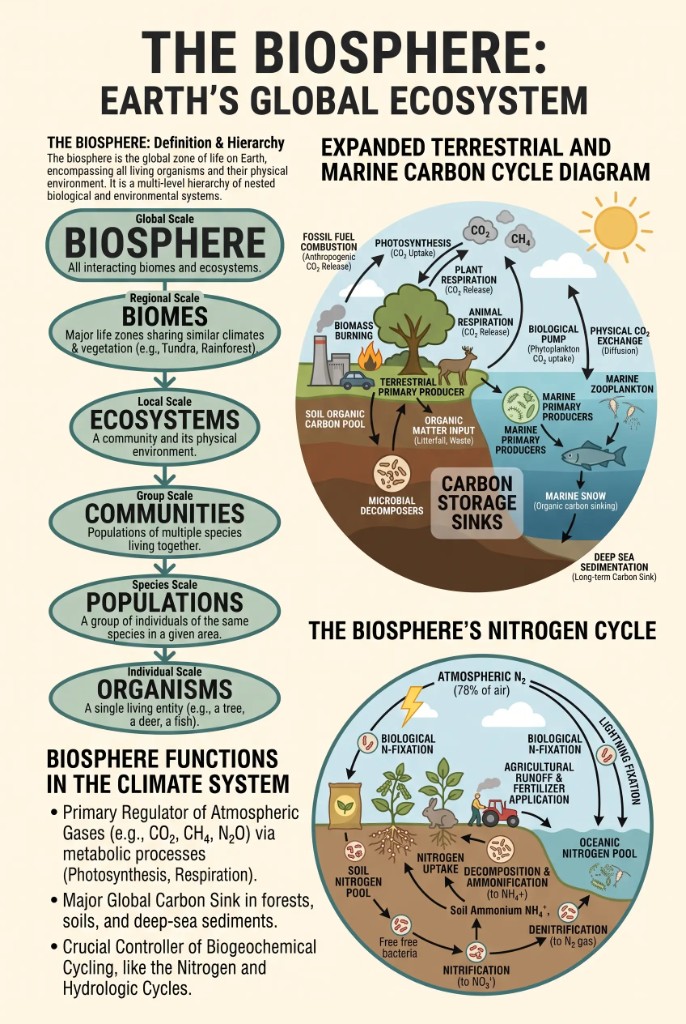
The Biosphere is the zone of life on earth. Parts of the atmosphere, hydrosphere and lithosphere that support life are in it. It is the global ecological system that encompasses all living organisms and their interactions with other spheres.
I have made the effort to put the gaiangineering website together is the hope that people can understand the processes that are destroying our biosphere and want to act in ways that help preserve it and the life within it.
The biosphere includes:
Living components: Plants, animals, microorganisms—essentially all life forms
Interactions with non-living components: Soil, water, air, and the energy flows that sustain life.
It spans from the deepest parts of the oceans to several kilometres into the atmosphere. It exists wherever life can exist.
It interacts with other Earth systems:
The lithosphere (land), hydrosphere (water), and atmosphere (air) to form a complex web of life supporting processes.
The biosphere is the zone of life on Earth, where biological and physical systems are interconnected, enabling ecosystems to function and evolve. It includes all living organisms and the interactions of their life with air water and land. It is the life commons in which we live.
Our biosphere has biomes, within them ecosystems with smaller communities and populations of organisms.
Living organisms are generally formally defined as any living thing that has an organized structure, can react to stimuli, reproduce, grow, adapt, and maintain homeostasis (a stable internal environment).
This definition includes every form of life on Earth
The first person known to make a systematic, scientific attempt to classify living things was the Greek philosopher, Aristotle (384–322 BC).
His work laid the fundamental groundwork for the science of taxonomy (the classification of organisms).
Aristotle's Early Classification System
Aristotle classified living things into two main groups, plants and animals, which established the ancient concept of the two kingdoms:
He then made further divisions based on observable characteristics, which were quite logical for the time, though later systems would find them limited:
-
Plants were classified based on their size and structure (e.g., trees, shrubs, and herbs).
-
Animals were classified in two primary ways:
-
Habitat: Air-dwellers, land-dwellers, and water-dwellers.
-
Possession of Blood: Animals with blood (equivalent to vertebrates) and animals without blood (equivalent to invertebrates).
-
While Aristotle was the first to formalize the concept, the foundation of the modern system of classification we use today (the hierarchical structure and binomial nomenclature) was established much later by the Swedish botanist Carl Linnaeus (born Carl Nilsson Linnaeus, 1707–1778) and he is now known as the "Father of Modern Taxonomy."
Linnaeus’s major contribution was the two part classification system of genus and species which is generally classified into three Domains and multiple Kingdoms:
Linnaeus standardized the way all scientists classify and name organisms, bringing order to what was previously a chaotic mix of long, descriptive common names.
His two most significant and lasting contributions are:
1. Binomial Nomenclature (The Two-Part Name)
Before Linnaeus, species were often given long, cumbersome descriptive names (like "Plant with deeply lobed leaves and a flower with a yellow center"). Linnaeus simplified this by giving every organism a unique two-part name, which is now the universal standard.
-
Format: Genus species
-
Genus: The first part, always capitalized, groups together closely related species.
-
species: The second part, always lowercase, refers to the specific organism within that genus.
|
Common Name |
Binomial Name |
Meaning/Example |
|
Human |
Homo sapiens |
Homo (man) is the genus; sapiens (wise) is the species. |
|
Lion |
Panthera leo |
Closely related to tigers (Panthera tigris) and leopards (Panthera pardus). |
|
Domestic Dog |
Canis familiaris |
Closely related to wolves (Canis lupus). |
Why it matters: This system is simple, universal, and prevents confusion by giving every species a single, globally recognized scientific name.
2. The Hierarchical Classification System (Taxonomic Ranks)
Linnaeus introduced a tiered, nested system of classification. Organisms are grouped into increasingly inclusive categories based on shared characteristics.
The standard Linnaean hierarchy, from most broad to most specific, is:
Kingdom=>{Phylum}=>Class=>Order=>Family=>Genus=>Species.
Modern taxonomy has added Domains (the broadest category) and uses evolutionary (phylogenetic) relationships rather than just physical similarities, the fundamental Linnaean ranks are still in use today.
Classification of a Gray Wolf Using Linnaean Nomenclature and Modern nomenclature
|
Linnaean System |
Current Day Modified Linnaean Classification |
||
|
Taxonomic Rank |
Classification |
||
|
Domain |
Eukaryota |
||
|
Kingdom: Animalia (All animals) |
Animalia |
Kingdom |
Animalia |
|
Phylum: Chordata (Animals with a spinal cord) |
Chordata |
Phylum |
Chordata |
|
Subphylum |
Vertebrata |
||
|
Class: Mammalia (Vertebrates that nurse their young) |
Mammalia |
Class |
Mammalia |
|
Subclass |
Theria |
||
|
Infraclass |
Eutheria (Placentalia) |
||
|
Superorder |
Laurasiatheria |
||
|
Order: Carnivora (Meat-eating mammals) |
Carnivora |
Order |
Carnivora |
|
Suborder |
Caniformia |
||
|
Family: Canidae (Canids: dogs, foxes, jackals) |
Canidae |
Family |
Canidae |
|
Subfamily |
Caninae |
||
|
Tribe |
Canini |
||
|
Genus: Canis (The dogs, wolves, and jackals) |
Canis |
Genus |
Canis |
|
Species: lupus |
Lupus |
Species |
Canis lupus Linnaeus, 1758 (Gray Wolf) |
|
Full Name: Canis lupus |
Canis lupus |
Binomial Name |
|
|
Subspecies |
Canis lupus familiaris |
||
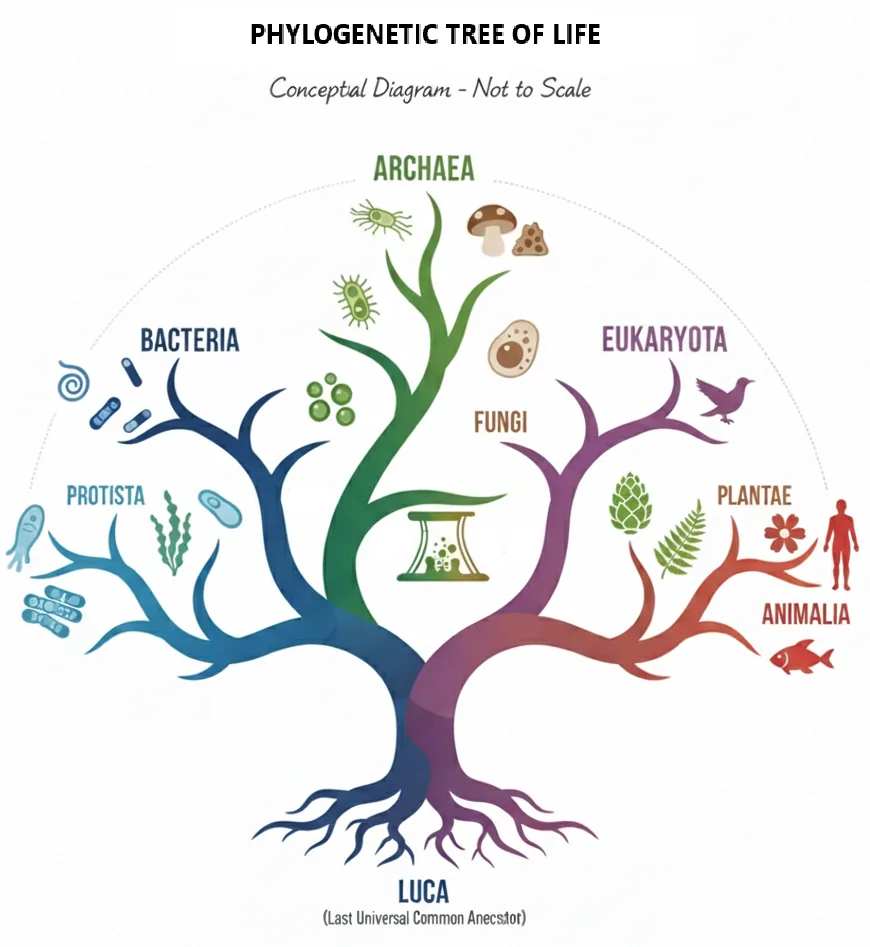
This classification reflects evolutionary relationships starting from the last universal common ancestor and attempts to give a scientific name that prevents confusion.
1. Domain: Bacteria (Prokaryotes)
-
Description: Single-celled microorganisms that lack a membrane-bound nucleus and other membrane-bound organelles. They are incredibly diverse, found in nearly every environment on Earth, and play crucial roles in ecosystems (e.g., nitrogen fixation, decomposition, disease, gut symbiosis).
-
Examples: E. coli, cyanobacteria, Lactobacillus, Streptococcus.
2. Domain: Archaea (Prokaryotes)
-
Description: Also single-celled microorganisms without a nucleus, superficially similar to bacteria. However, they have distinct genetic, biochemical, and structural features that set them apart. Many are known for living in extreme environments (extremophiles), but they are also common in soils, oceans, and even in the human body.
-
Examples: Methanogens (produce methane), halophiles (live in high salt), thermophiles (live in high heat).
3. Domain: Eukaryota (Eukaryotes)
-
Description: Organisms whose cells contain a nucleus and other membrane-bound organelles. This domain is incredibly diverse and includes all multicellular life forms, as well as many single-celled organisms.
-
Kingdoms within Eukaryota:
-
Protista: A very diverse, somewhat informal grouping of mostly single-celled eukaryotes that don't fit neatly into the other kingdoms. Includes algae, amoebas, paramecia, and slime molds.
-
Fungi: Mostly multicellular (though yeasts are unicellular) organisms that obtain nutrients by absorbing organic material from their environment. They have cell walls made of chitin. Includes mushrooms, molds, and yeasts.
-
Plantae (Plants): Multicellular organisms that are primarily photosynthetic, meaning they produce their own food using sunlight. They have cell walls made of cellulose. Includes mosses, ferns, conifers, and flowering plants.
-
Animalia (Animals): Multicellular organisms that are heterotrophic (obtain food by consuming other organisms). They are typically motile and lack cell walls. Includes insects, fish, birds, mammals, and humans.
-
To summarise, the term organism covers everything from the smallest, single-celled bacterium to the largest blue whale or giant redwood tree.
Ecological Hierarchy: Differences in Scale and Components
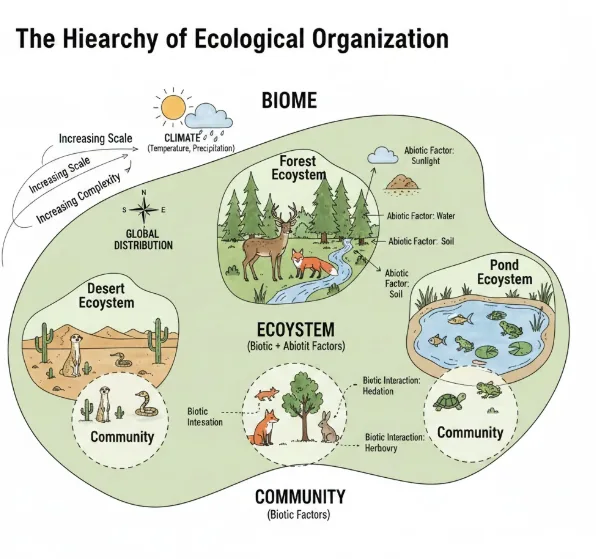
The following three terms describe increasingly larger and more complex levels of ecological organization.
1. Community
A community is the most localized and smallest level of these three concepts.
-
Definition: An assemblage of all the different populations of organisms (plants, animals, fungi, microbes) that live and interact in a particular area.
-
Components: Strictly Biotic (living) factors.
-
Focus: Inter-species relationships, such as competition, predation, and symbiosis.
-
Life & Habitat Relation: The community represents the life itself—the interacting populations—that occupy a shared physical habitat.
2. Ecosystem
An ecosystem is a comprehensive functional unit that includes a community and its environment.
-
Definition: All the living organisms (community) in a particular area, interacting with the non-living (abiotic) components of that environment.
-
Components: Biotic (the community) and Abiotic (non-living) factors like water, air, soil, sunlight, and temperature.
-
Focus: The flow of energy and the cycling of nutrients between the living and non-living parts of the system.
-
Life & Habitat Relation: An ecosystem describes the system where life (the community) is intimately linked to and shaped by its physical habitat (the abiotic factors).
3. Biome
A biome is the largest and most geographically extensive classification, encompassing multiple related ecosystems.
-
Definition: A vast ecological region characterized by its specific climate (primarily temperature and precipitation) and the resulting dominant plant life (e.g., forest, grassland, desert).
-
Components: Multiple similar Ecosystems that share a common environmental background.
-
Focus: Global distribution patterns of life and the adaptations of organisms to a broad climate regime.
-
Life & Habitat Relation: A biome defines a major type of large-scale habitat (e.g., the Tundra biome) that supports a specific type of life adapted to that region’s characteristic climate.
Similarities and Interdependence
Despite their different scales, communities, ecosystems, and biomes are all fundamentally similar in that they describe structured environments essential for sustaining life.
|
Area of Similarity |
Explanation |
|
Foundation of Life |
All three structures are necessary to describe where life exists. A community is the collection of life; an ecosystem is the environment that supports life; and a biome is the global categorization of life based on climate adaptation. |
|
Nested Hierarchy |
They are hierarchically nested within one another: a Community is part of an Ecosystem, and multiple similar ecosystems make up a Biome. This relationship ensures that processes at the smaller scale contribute to the function of the larger scale. |
|
Link to Habitat |
Each term is a way to classify the habitat of organisms. A habitat is the specific place where an organism lives; a community is all the life in that place; an ecosystem is the life and the non-living habitat together; and a biome is a regional group of similar habitats. |
|
Ecological Interactions |
They all involve complex interactions: Communities involve biotic-biotic interactions; Ecosystems involve biotic-abiotic interactions; and Biomes involve similar species adaptations and environmental controls across large geographic areas. |
References
-
Aristotle. (n.d.). History of Animals. Retrieved from https://en.wikipedia.org/wiki/History_of_animals
-
Campbell, N. A., & Reece, J. B. (2005). Biology (7th ed.). San Francisco: Pearson Benjamin Cummings.
-
Linnaeus, C. (1758). Systema Naturae. Stockholm: Laurentii Salvii.
-
National Center for Biotechnology Information (NCBI). (2025). Taxonomy Browser. Retrieved from https://www.ncbi.nlm.nih.gov/Taxonomy/Browser/wwwtax.cgi
-
Odum, E. P. (1971). Fundamentals of Ecology (3rd ed.). Philadelphia: W.B. Saunders.
-
Ricklefs, R.E. and Relyea, R. (2014) Ecology: The Economy of Nature. 7th edn. New York: W.H. Freeman and Company.
-
Schulze, E.-D., Beck, E. and Müller-Hohenstein, K. (2005) Plant Ecology. Berlin: Springer.
-
Wikipedia contributors. (2025). Wolf. In Wikipedia. Retrieved from https://en.wikipedia.org/wiki/Wolf