
Earth's Spheres and Ecological Resonance
John Harrison
Abstract
Conventional environmental models frequently mischaracterize nature as a passive backdrop—a static reservoir from which resources are extracted and into which waste is deposited. This paper presents the foundational taxonomy used across Gaiaengineering, unifying Earth's natural life-support spheres with the four connected components of the Anthroposphere: the Sociosphere, Technosphere, Econosphere, and Politisphere. Drawing upon the Technosphere model formalised by Zalasiewicz et al. (2017), we examine how human systems force changes across interconnected global cycles. Integrating concepts from chaos theory—specifically the "butterfly effect"—and the physics of acoustic resonance, we demonstrate that planetary ecology functions as an active, living instrument. Rather than relying on brute-force, high-cost mechanical management of global ecosystems, industrial ecology must apply targeted, biocompatible catalysts ("sympathetic resonance") to trigger Earth’s built-in self-organizing mechanisms for low-cost, maximum-impact planetary recovery.
1. Introduction: From Static Backdrop to Resonant Instrument
To understand planetary degradation, humanity must first discard the illusion of a static environment. In physical geography and early industrial models, nature was treated as a constant—an infinitely resilient landscape against which human progress unfolded. This assumption is fundamentally flawed. Earth’s ecology is a dynamic, highly sensitive, and non-linear web of functional dependencies.
Decades ago, chaos theory introduced the paradigm of non-linear dynamics: the notion that the subtle flap of a butterfly’s wings in the Amazon rainforest could set off a cascade of atmospheric perturbations culminating in a storm half a world away. This metaphor illustrates the profound interlock of global systems. Small inputs in one node of an ecological web reverberate across the entire system. When synthetic pesticides disrupt soil biology, the loss of microbial activity collapses insect populations, which starves bird communities, alters seed dispersal, and eventually destabilizes agriculture and hydrology. Everything in the planetary engine is coupled.
When human activity treats nature as a passive depot, industrial processes strike disruptive notes across these interconnected networks. Reversing planetary breakdown requires a consistent taxonomy that accounts for both natural biogeochemical systems and the four human mechanisms driving them.
2. Taxonomy of Natural Life-Support Spheres
Cataloguing research and engineering interventions across Earth systems requires a consistent taxonomy. Gaiaengineering establishes the baseline physical and biological environment across four primary natural spheres:
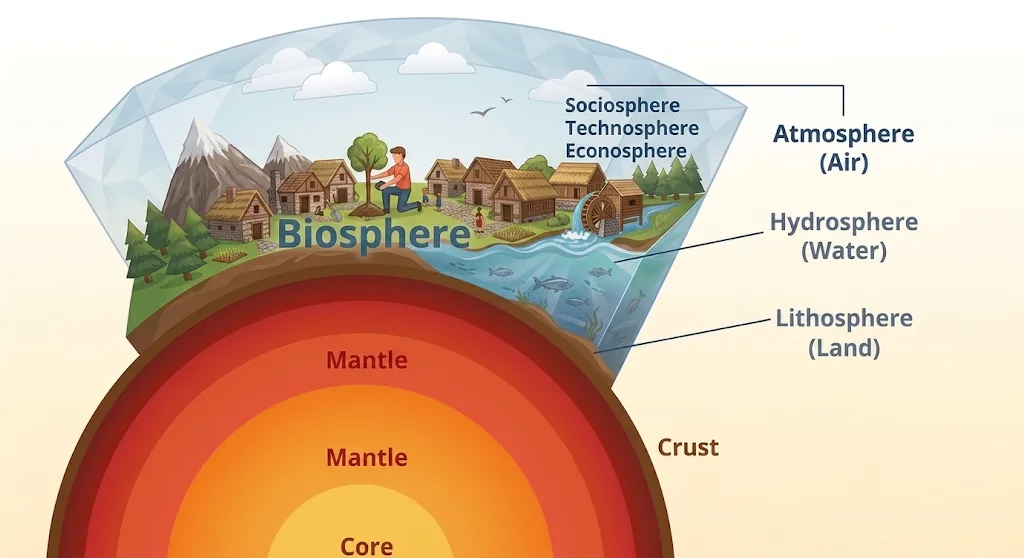
- Atmosphere: Earth’s gaseous envelope (~78% nitrogen, ~21% oxygen, plus argon, CO₂, methane, and trace gases) organized into five distinct layers (troposphere, stratosphere, mesosphere, thermosphere, and exosphere). It regulates the planetary energy balance, drives weather cycles, circulates moisture, and shields the surface from ultraviolet radiation and meteoritic impacts.
- Hydrosphere: All water across liquid, solid, and vapor states—including oceans, rivers, lakes, groundwater, glaciers, and atmospheric moisture. Water’s high heat capacity acts as Earth's thermal distribution system, setting global sea levels and stabilizing climate regimes.
- Lithosphere: The rigid outer crust and uppermost mantle, segmented into moving tectonic plates. It yields essential minerals and geological energy, forms soils at the biological boundary, and regulates atmospheric carbon over geological timescales through rock weathering.
- Biosphere / Ecosphere (The Living Web): The functional matrix containing all living organisms, ecosystems, and biological networks. Beyond mediating foundational biogeochemical cycles (photosynthesis, nitrogen fixation, biological decay), ecology represents the functional linkages holding life together. Disruption at high altitudes—such as climate-driven glacial collapses in mountain ranges like the Himalayas—cascades down river basins, altering sediment dynamics, destroying aquatic habitats, and impacting freshwater security for billions downstream.
3. The Anthroposphere: Four Connected Components
Overlaid upon these natural life-support spheres is the Anthroposphere—the human-made world comprising everything humans build, use, organize, and discard. Adapting Earth-system science models (Zalasiewicz et al., 2017), Gaiaengineering evaluates the Anthroposphere through four coupled components that drive planetary change:
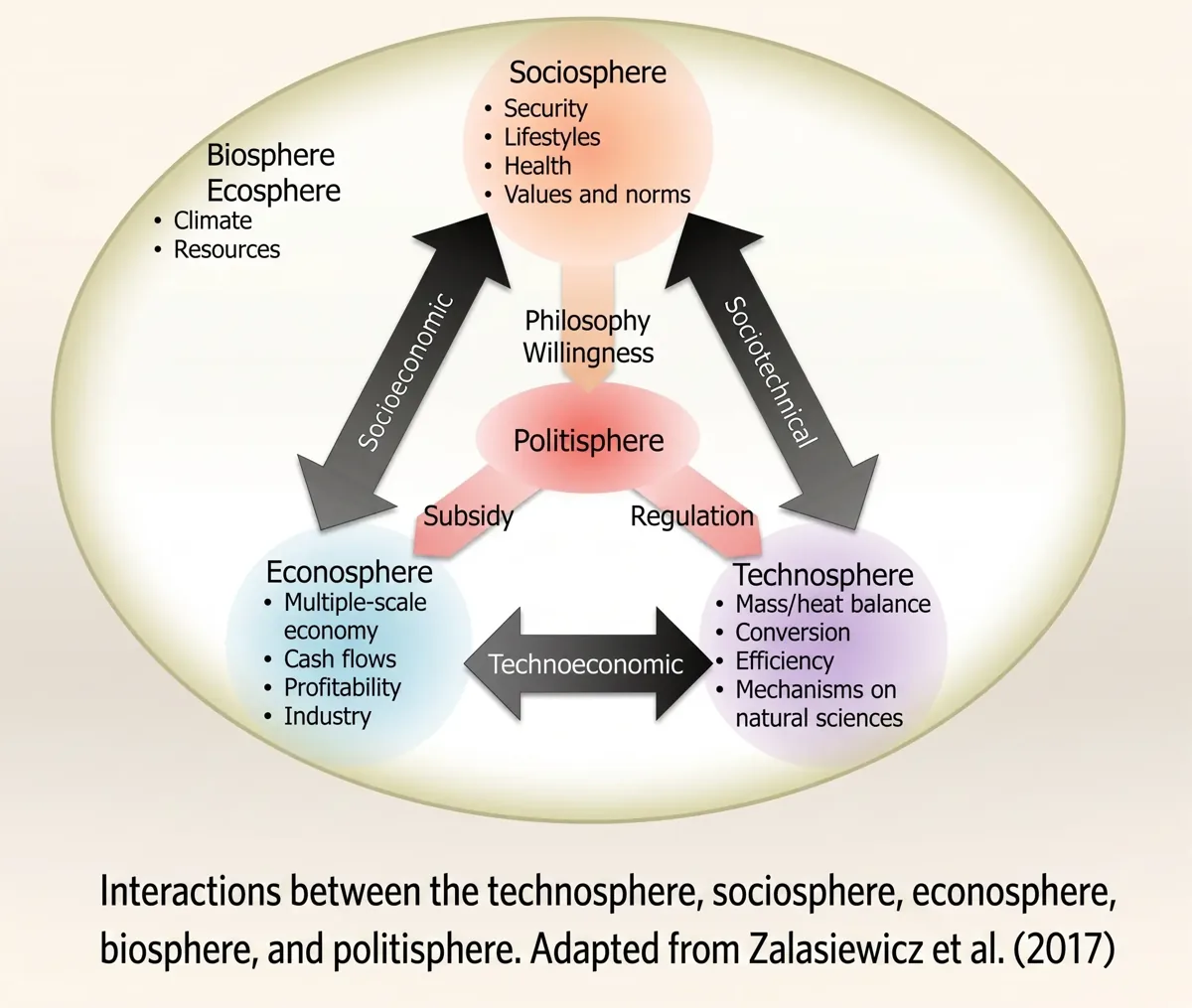
| Component | Definition & Scope | Structural Role in Global Systems |
|---|---|---|
| Sociosphere | Human populations, health, security, lifestyles, values, and cultural norms. | The human domain containing labor, social cohesion, community ethics, and collective intent. |
| Technosphere | Tools, infrastructure, machines, built environment, and physical conversion systems. | The central engine processing physical material and energy flows, formalised by Zalasiewicz et al. (2017). |
| Econosphere | Capital flows, cash metrics, profitability, markets, and multi-scale industry. | The incentive framework directing physical material usage, resource extraction, and labor allocation. |
| Politisphere | Governance, regulatory frameworks, policy boundaries, subsidies, and legal structures. | The supervisory system directing institutional oversight, regulatory limits, and public incentives. |
As formalised by Zalasiewicz et al. (2017), the Technosphere has scaled to weigh tens of trillions of tons, functioning as an off-balance subsystem that extracts raw materials from natural spheres and discharges uncoordinated waste streams back into them. The Technosphere does not steer itself; social values (Sociosphere), financial incentives (Econosphere), and policy directives (Politisphere) allocate capital, set rules, and create demand.
4. The Physics of Ecological Harmony: Dissonance vs. Sympathetic Resonance
To understand how human interventions must interact with Earth's natural spheres, consider the physics of sound and resonance.
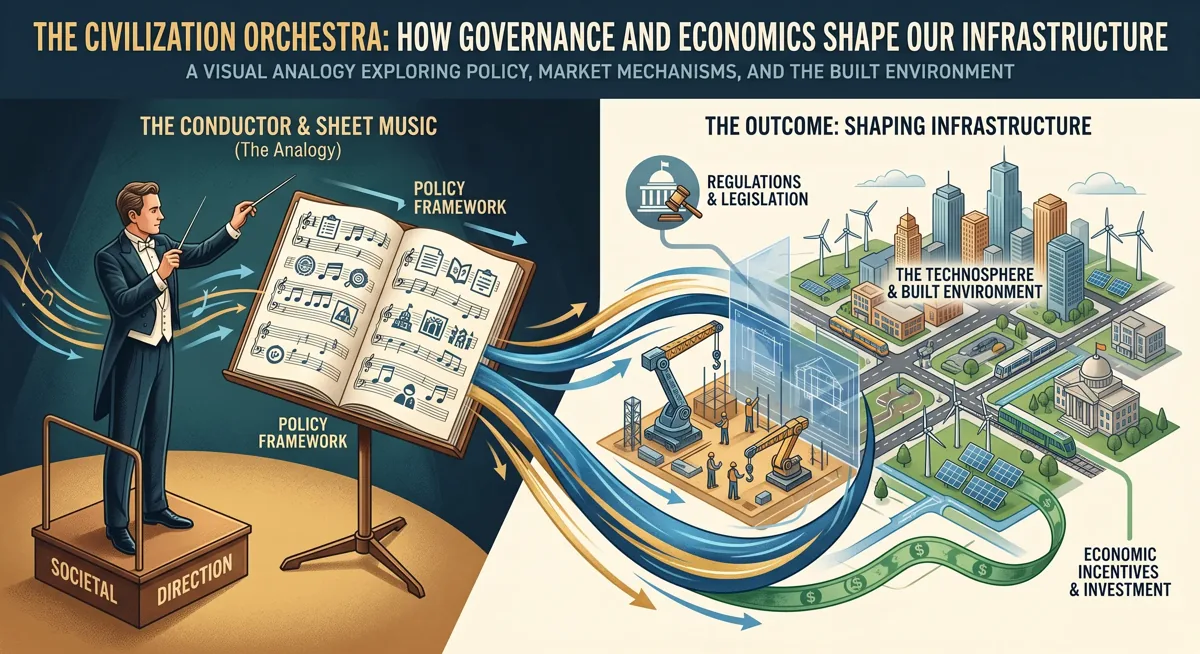
Earth’s Biosphere/Ecosphere operates like a massive pipe organ constructed over 3.8 billion years of evolution. Each biological network, species relationship, and hydrological cycle acts as an individual pipe, physically coupled to every other through global air, water, and nutrient flows.
Industrial Dissonance
Currently, human society approaches the planet with brute force. Slamming heavy hands onto an organ keyboard does not create music; it produces screeching feedback and damages the internal action. Chemical pollution, topsoil degradation, and linear carbon emissions represent violent, dissonant strikes that disrupt the instrument’s natural tuning.
The Conductors and Sheet Music
The Technosphere is merely the finger pressing down on the key. The "sheet music" is written by our societal values (Sociosphere), economic incentives (Econosphere), and regulatory parameters (Politisphere). If our political and financial systems demand disharmony, the Technosphere plays noise. If our incentives demand harmony, technology becomes the tool that strikes the correct chord.
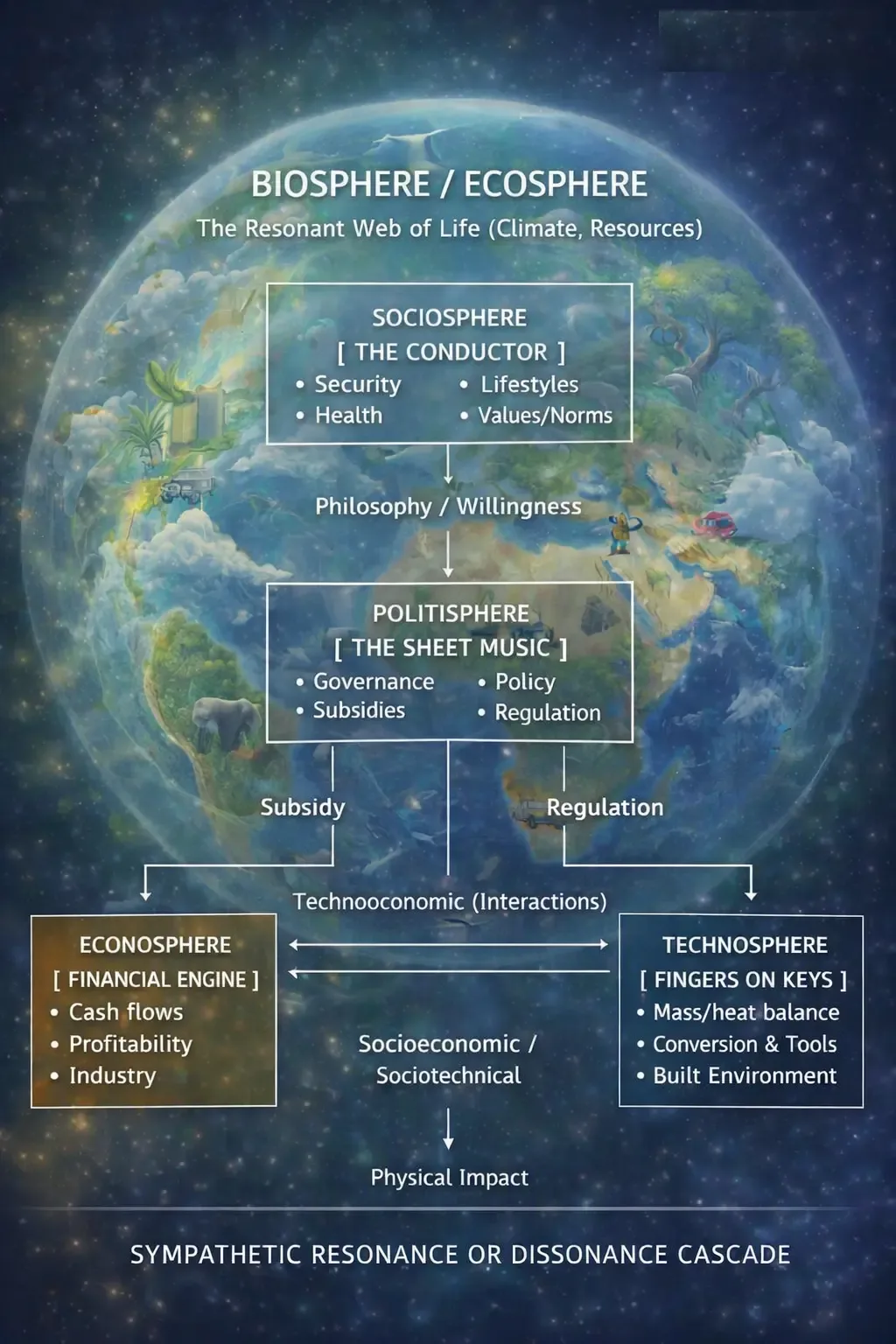
Sympathetic Resonance and Low-Cost Catalysis
In acoustics, sympathetic resonance occurs when vibrating one pipe causes every tuned pipe in the surrounding space to hum in unison without being touched directly.
- Brute-Force Geoengineering: Attempting to mechanically build, clean, or manage every biological cycle. This requires vast expenditures of capital and energy, with high risks of triggering new non-linear systemic failures.
- Ecological Catalysis: Striking a precise, biocompatible key—such as reintroducing soil microbiology, enhancing natural mineral weathering, or eliminating bio-accumulative toxins. Because the planet’s living web is already built to resonate, nature amplifies that single, smart intervention across the entire system. Applying the right key delivers the maximum ecological change at the lowest economic cost.
5. Industrial Ecology as a Catalytic Lever
This resonant paradigm is the core foundation of Industrial Ecology and Gaiaengineering. Industrial Ecology recognizes that technological infrastructure cannot exist outside nature's rules; it must mirror biological cycles by turning waste streams into productive inputs.
By aligning the Technosphere with ecological principles, we stop slamming heavy hands onto the organ's keys. Examples of catalytic interventions include:
- Soil & Carbon Catalysis: Deploying accelerated rock weathering and biocompatible mineral additions to capture atmospheric carbon while restoring soil mineral balance and microbial vitality.
- Circular Materials: Redesigning industrial chemistries so that outputs are natively non-toxic to soil and aquatic ecology, preventing cascading biological collapses.
- Socio-Economic Alignment: Structuring Politisphere policy and Econosphere capital to reward technospheric innovations that actively rebuild ecological capital.
Conclusion
Humanity cannot survive on a broken instrument. Nature is not a silent supply depot, but a living web where a perturbation in one sphere ripples through every other. The crisis facing modern civilization stems from a Technosphere designed without regard for ecological resonance. By leveraging this taxonomy of Earth’s spheres (Zalasiewicz et al., 2017) and applying the principles of Industrial Ecology, Gaiaengineering focuses on high-leverage, catalytic interventions. Striking the right keys will allow Earth's self-organizing ecological engine to repair itself, securing a functional, stable planet for human civilization to continue.
References
- Lorenz, E. N. (1972). Predictability: Does the Flap of a Butterfly’s Wings in Brazil Set Off a Tornado in Texas? American Association for the Advancement of Science.
- Zalasiewicz, J., Williams, M., Waters, C. N., Barnosky, A. D., Palmesino, J., Rönnskog, A. S., Edgeworth, M., Neal, C., Cearreta, A., Ellis, E. C., Grinevald, J., Haff, P. K., Ivar do Sul, J. A., Jeandel, C., Leinfelder, R., McNeill, J. R., Steffen, W., Summerhayes, C., Wagreich, M., & Wolfe, A. P. (2017). Scale and diversity of the Physical Technosphere: A metric for the Anthropocene. The Anthropocene Review, 4(1), 9–22.